
Key takeaways
- The working capital peg is negotiated at LOI, after signing, the methodology is locked; a founder who discovers deferred revenue will be treated as debt-like during purchase agreement drafting has no leverage to change the structure
- Deferred revenue, customer deposits, accrued PTO, and earnout-linked bonus accruals are routinely treated as debt-like items, and they reduce net proceeds dollar-for-dollar and most founders never model them pre-LOI
- Peg methodology selection matters for seasonal businesses: trailing 12-month average, spot (most recent month end), and last fiscal year end produce materially different pegs depending on when the deal closes
- On a $700K deferred revenue balance, the buyer treats it as a debt-like item, the effective enterprise value received is $700K less than the headline number, regardless of what the P&L shows
- A two-hour working capital review with a sell-side advisor before engaging a banker is one of the highest-ROI pre-process conversations available, the goal is understanding the peg before LOI, not after
In this article
- What working capital actually means in a transaction
- The items that most often surprise sellers
- How the peg is set and why it matters
- What to do before you go to market
- Closing date timing strategy: why month-end and quarter-end matter
- LOI-to-close working capital bridge: tracking the drift
- Common mistakes founders make on working capital peg mechanics.
- Post-close closing statement disputes: the independent accountant resolution process
How to use this before a process
What working capital actually means in a transaction
For adjacent context, compare this with Earnouts in M&A: Why Founders Don't Get Paid What They Expect and Working Capital Targets in M&A: The Deal Term Founders Underestimate; the strongest operators connect these topics instead of treating them as separate workstreams.
Earnout Terms to Lock Before LOI
- Define the metric, measurement period, accounting rules, and dispute process in writing.
- Model the payout at base, downside, and buyer-controlled operating scenarios.
- Cap overhead allocations and integration charges that can move the metric after close.
- Require reporting access during the earnout period, not just after a missed payout.
- Know what happens if the buyer sells, merges, or reorganizes the acquired business.
Working capital in a transaction context means current assets minus current liabilities, with specific items included and excluded based on the deal structure. The standard structure is "cash-free, debt-free", the seller keeps cash and repays debt at close, and the business is delivered with a normalized level of working capital.
Readiness Snapshot
What buyers will ask
What exactly triggers payment, and who controls the metric?; Which post-close decisions can change the result without violating the agreement?; How will disputes be resolved if the buyer and seller calculate the metric differently?
What to prepare
Earnout model with base, upside, and downside scenarios.; Draft metric definitions and accounting policy assumptions.; Post-close reporting rights and dispute process summary.
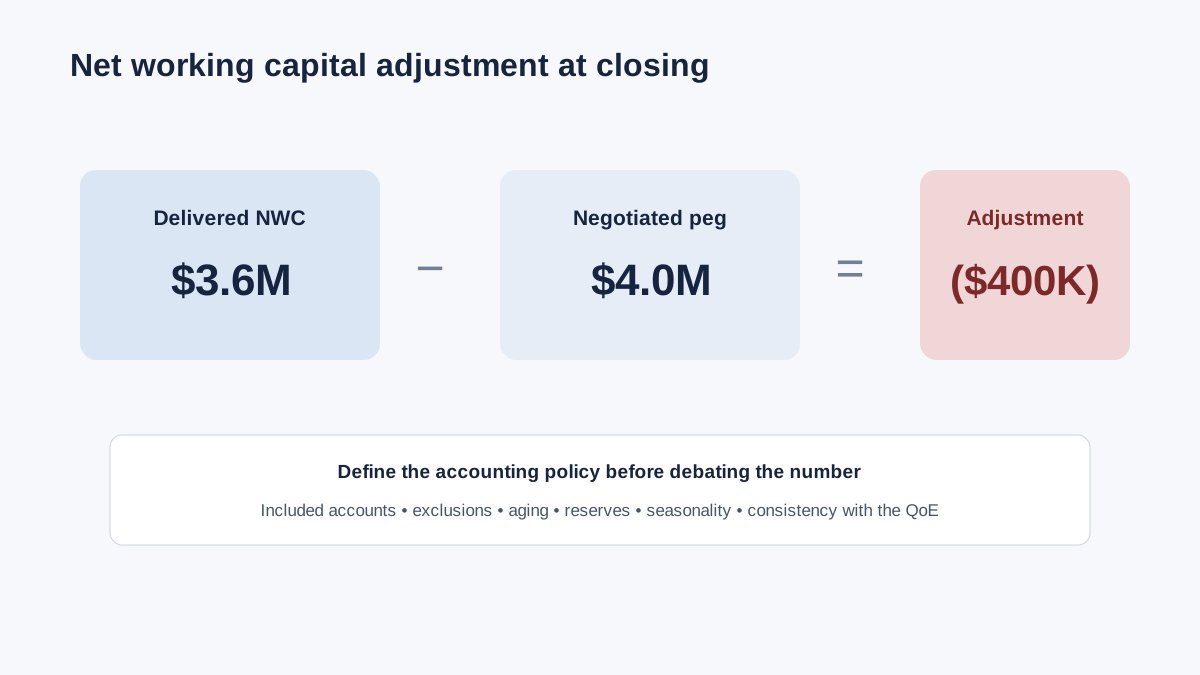
The working capital peg is the agreed target level of working capital that should be in the business at closing. If closing working capital is above the peg, the buyer pays more. If it is below the peg, the seller receives less. The delta goes dollar for dollar. On a business where working capital typically runs $2.5M and closing comes in at $1.8M, the seller gives back $700K.
Key working capital definitions
The items that most often surprise sellers
Most founders understand that accounts receivable and accounts payable are in working capital. What surprises them are the items that buyers treat as "debt-like" and exclude from working capital or treat as dollar-for-dollar adjustments to the purchase price.
Deferred revenue|Recognized as a liability on the balance sheet; buyer treats as debt-like because they must deliver the service post-close without corresponding cash
Customer deposits|Same treatment as deferred revenue, buyer inherits the obligation
Accrued paid time off|If employees carry over PTO, the accrued liability is often treated as debt
Earnout-linked liabilities|Bonus accruals tied to performance that crosses fiscal year
Seller-paid customer credits|Credits issued pre-close that the buyer must honor post-close
Lease make-whole provisions|If a real estate lease has unfavorable terms relative to market, buyer may treat the overage as a price reduction
A manufacturing business sold for $14.5M on 6.5x EBITDA.
The seller had approximately $1.1M in deferred revenue on the balance sheet from annual service contracts billed in January for the full year. The buyer treated all deferred revenue as a debt-like item, the seller would receive cash for work not yet performed, and the buyer would be required to deliver that work post-close. The deferred revenue adjustment reduced net proceeds by $1.1M.
The seller had not modeled this in their expected proceeds calculation. The effective enterprise value received was $13.4M, not $14.5M.
How the peg is set and why it matters
The working capital peg is negotiated during the LOI stage, not the purchase agreement stage. After LOI signing, the methodology is essentially locked. The buyer will commission a <a href="/insights/quality-of-earnings-report-founder-guide" class="subtle-link">quality of earnings</a> analysis that includes a working capital assessment, and the purchase agreement will be drafted around whatever peg methodology was agreed in the LOI.
The most common peg methodology is trailing 12-month average working capital, calculated monthly. This tends to smooth seasonality. Some buyers push for spot (most recent month end) or last fiscal year end, both can be more or less favorable depending on the business's seasonal pattern and when in the year the deal closes.
Peg methodology comparison for seasonal businesses
AI diligence angle
Run a short scan to identify reporting, data room, and workflow gaps that could affect diligence confidence.
Run an AI readiness scan →What to do before you go to market
The single most valuable preparation step for working capital is a self-assessment of what the buyer will treat as debt-like. Walk through every liability on your balance sheet with your accountant and your advisor. For each one, ask: will the buyer treat this as a working capital item or a debt-like item? The answer determines how proceeds are calculated.
If you have significant deferred revenue or customer deposits, model the peg adjustment explicitly before you start a process. Know what your trailing 12-month average working capital is. Know what it would be if deferred revenue were excluded. That delta is real money at closing.
One of the highest-ROI conversations you can have before engaging a banker is a two-hour working capital review with a sell-side advisor. The goal is not to manipulate the number, it is to understand it so you are not surprised at close, and so you can negotiate the peg methodology with full information during the LOI stage when leverage still exists.
Closing date timing strategy: why month-end and quarter-end matter
The date a transaction closes affects working capital in ways that are predictable and, to a meaningful degree, controllable. Sellers who understand the seasonal and billing-cycle dynamics of their working capital can influence closing timing to improve net proceeds at close. Buyers understand this too, closing date timing is sometimes a negotiating point in its own right.
Sellers typically prefer month-end or quarter-end closes for a straightforward reason: these are the moments when receivables tend to be highest (invoices have been issued, collections are pending) and certain payables are at their lowest (payroll and vendor payments have recently been made or are not yet due). Higher receivables and lower payables produce higher working capital, which means either meeting a high peg more easily or generating a positive working capital adjustment that increases closing proceeds.
Closing date timing effects
Buyers who understand this dynamic sometimes push for mid-month closes to reduce the working capital they deliver, or to reduce the peg adjustment they are exposed to. In practice, closing date is determined primarily by diligence timeline and regulatory requirements, not by WC optimization, but when timing flexibility exists, sellers should model the WC impact of different closing dates before agreeing to a specific close date.
A timing-neutral peg is negotiated by setting the peg based on a long-period average that smooths out billing cycle effects, typically an 18 or 24-month trailing average rather than a 12-month average. This approach removes the incentive for either party to optimize closing timing to game the peg calculation, and it produces a more defensible baseline for the actual ordinary-course WC requirement of the business.
LOI-to-close working capital bridge: tracking the drift
From the moment an LOI is signed to the date of closing, working capital can drift materially from the baseline used to set the peg. In a 60 to 90-day exclusivity period, a number of normal business activities can create a meaningful gap between the agreed peg and the actual closing working capital, and that gap is a dollar-for-dollar proceeds reduction or increase at close.
The most common drivers of working capital drift during the LOI-to-close period are: seasonal inventory builds (particularly for businesses in Q4 retail cycles or spring construction cycles), deferred maintenance payments (vendors who were stretching payment terms allow the situation to normalize during the process), payables acceleration (buyers or their advisors signal that payables are stretched; sellers allow them to normalize, which reduces net WC), and pre-close collection management (sellers who aggressively collect receivables before close improve WC temporarily, but buyers will normalize the peg for this).
Common causes of working capital drift during LOI-to-close
The most reliable defense against working capital drift is a weekly tracking sheet maintained from LOI signing through close. For each major working capital component, accounts receivable, accounts payable, inventory, deferred revenue, accrued liabilities, track the balance weekly and compare it to the peg baseline. When drift exceeds $100K from the agreed peg, the seller and advisor should assess whether it is seasonal (temporary, will reverse before close), structural (will persist to closing date and affect proceeds), or controllable (management action can address it).
Buyers sometimes use the LOI-to-close period to introduce new WC methodology arguments. A buyer who agreed to trailing 12-month average at LOI but then argues in the purchase agreement that deferred revenue should be excluded from the WC calculation, or that a specific accrual should be treated as a debt-like item, is attempting to move the peg post-exclusivity. Sellers should resist any WC methodology changes after LOI signing, as these changes are almost always buyer-favorable and the seller has limited leverage to push back once exclusivity is granted.
Common mistakes founders make on working capital peg mechanics.
Post-close closing statement disputes: the independent accountant resolution process
Even after closing, working capital is not settled. The buyer delivers a post-closing working capital statement, typically within 60–90 days of close, showing the actual working capital delivered as of the closing date compared to the agreed peg. If there is a gap, the seller owes money. If working capital exceeded the peg, the buyer owes money. This closing statement is where many disputes begin.
The resolution process for working capital disputes follows a defined sequence written into most middle market purchase agreements. Understanding the timeline and mechanics in advance prevents sellers from being caught flat-footed when the buyer delivers a closing statement that is materially different from what they expected.
Step 1: Buyer prepares and delivers a Closing Statement
Typically 60–90 days after the closing date; includes detailed working capital calculation as of the closing date with all component balances
Step 2: Seller review period
Typically 30–45 days from receipt; seller can review the calculation, request supporting documentation, and identify any items they dispute
Step 3: Seller delivers a Notice of Disagreement
If the seller disputes any item, they must deliver a written Notice of Disagreement within the review period specifying the contested items and the seller's proposed amounts; failure to deliver on time is typically deemed acceptance of the buyer's statement
Step 4: Good faith negotiation period
Typically 30 days; buyer and seller attempt to resolve disputed items through direct negotiation; most disputes settle here
Step 5: Independent Accountant determination
If good faith negotiation fails, the disputed items are submitted to a mutually agreed neutral accounting firm; the independent accountant acts as an expert, not an arbitrator, and their determination is binding and not subject to further appeal
Step 6: Allocation of fees
The independent accountant's fees are allocated between buyer and seller in proportion to which party's position was further from the final determination
The independent accountant is not an arbitrator. They are an accounting expert hired to resolve disputed calculations, not legal or contractual questions. Disputes about whether a peg methodology was agreed in the LOI are legal questions that go to arbitration or litigation, not to the independent accountant. The accountant's scope is limited to the contested items as specified in the Notice of Disagreement, and the accountant cannot award an amount outside the range between the buyer's and seller's positions. A seller who fails to preserve rights in the Notice of Disagreement permanently forfeits them.
Scroll to see more →
A distribution business closed with an agreed $2.4M working capital peg.
The buyer's closing statement showed $1.9M, a $500K shortfall, primarily driven by the buyer treating $380K of deferred service contract revenue as a debt-like adjustment. The seller had believed deferred revenue was included in the working capital calculation, not excluded as a debt-like item. The seller delivered a Notice of Disagreement within the 30-day window. In good faith negotiation, the buyer agreed to release $180K of the adjustment. The remaining $200K deferred revenue question was submitted to an independent accountant. The accountant found that the purchase agreement's working capital definition had not explicitly excluded deferred revenue, and awarded $160K to the seller. Net resolution: seller received $340K more than the buyer's original closing statement.
Seller advisory cost: $28K. Net benefit after costs: $312K.
60–90 days
Typical window for buyer to deliver post-closing WC statement
30–45 days
Seller's review and objection window; missing it = accepting the buyer's number
50–70%
Working capital disputes that settle in good faith negotiation before reaching an independent accountant
Frequently asked questions
What is the working capital peg in an M&A transaction?
The working capital peg is the target level of working capital agreed between buyer and seller. If the business delivers more than the peg at closing, the buyer pays more. If it delivers less, the seller receives less. It is typically set as a trailing 12-month average of monthly working capital and negotiated as part of the LOI.
What are debt-like items in a transaction?
Debt-like items are balance sheet liabilities that the buyer treats as economically equivalent to debt, the seller must repay or absorb them as a price adjustment. Common examples include deferred revenue, customer deposits, accrued PTO, and certain earnout-linked bonus accruals.
Can working capital adjustments be negotiated?
Yes, and the best time to negotiate them is before LOI signing. After signing, the methodology is locked. A seller who understands which items will be treated as debt-like can push for a more favorable peg methodology or negotiate specific items out of the adjustment mechanism during the LOI stage.
How much can working capital change between LOI signing and closing?
In most lower-middle-market transactions with a 60 to 90-day exclusivity period, working capital drift of $200K to $700K is common. The direction and magnitude depend on seasonal business cycles, billing timing, and management actions during the exclusivity period. A weekly WC tracking bridge from LOI to close is the most effective tool for anticipating the final closing adjustment.
What causes a working capital shortfall at closing?
The most common causes are: payables that were stretched normalizing before close (increasing current liabilities and reducing net WC), receivables that decline below the peg period average, seasonal inventory depletion, and deferred maintenance payments coming due. All of these reduce net WC and reduce proceeds at close.
Can I control working capital during the LOI-to-close period?
Yes, within limits. Sellers can manage the timing of large payables, monitor AR collection aggressively, and avoid creating new current liabilities during the exclusivity period. However, attempts to artificially inflate WC above the peg period average (by accelerating collections, stretching payables beyond normal terms, or delaying inventory orders) will be normalized by the buyer's QoE team and will not produce a lasting improvement in net proceeds.
Work with Glacier Lake Partners
Get help modeling your working capital peg
Working capital adjustments at closing can shift net proceeds by hundreds of thousands. We help founders model the peg before the LOI.
Start a Conversation →AI diligence angle
See where AI can clean up readiness before buyers ask.
Run a short scan to identify reporting, data room, and workflow gaps that could affect diligence confidence.
Run an AI readiness scan →Research sources
Disclaimer: Financial figures and case-study details in this article are anonymized, composite, or representative examples based on middle market operating situations, and are not guarantees of outcome. Statistical references are drawn from cited third-party research; individual transaction and operational results vary based on business characteristics, market conditions, and deal structure. This content is for informational purposes only and does not constitute legal, financial, or investment advice. Consult qualified advisors for guidance specific to your situation.
Explore adjacent topics