
Key takeaways
- AI implementations fail because of missing workflow ownership, not missing technology. A tool assigned to "the team" with no named owner stalls at the first imperfect output.
- Organizations that document an output standard before deployment reach production quality in 30–45 days. Those that don't average 90–120 days, and usually still fail.
- Assign a named owner to every AI workflow before deployment. Not a team, one person with explicit accountability for output quality.
- Start with one high-repetition task and measure time saved before expanding. The first success builds the governance muscle that makes the second implementation faster.
- Durable AI adoption requires a documented output standard, a named owner, and a structured review cadence, not just a license.
Most lower middle market businesses that have experimented with AI describe the same experience: a pilot that looked promising, an enthusiastic kickoff, and then six months later a tool that nobody uses for anything important.
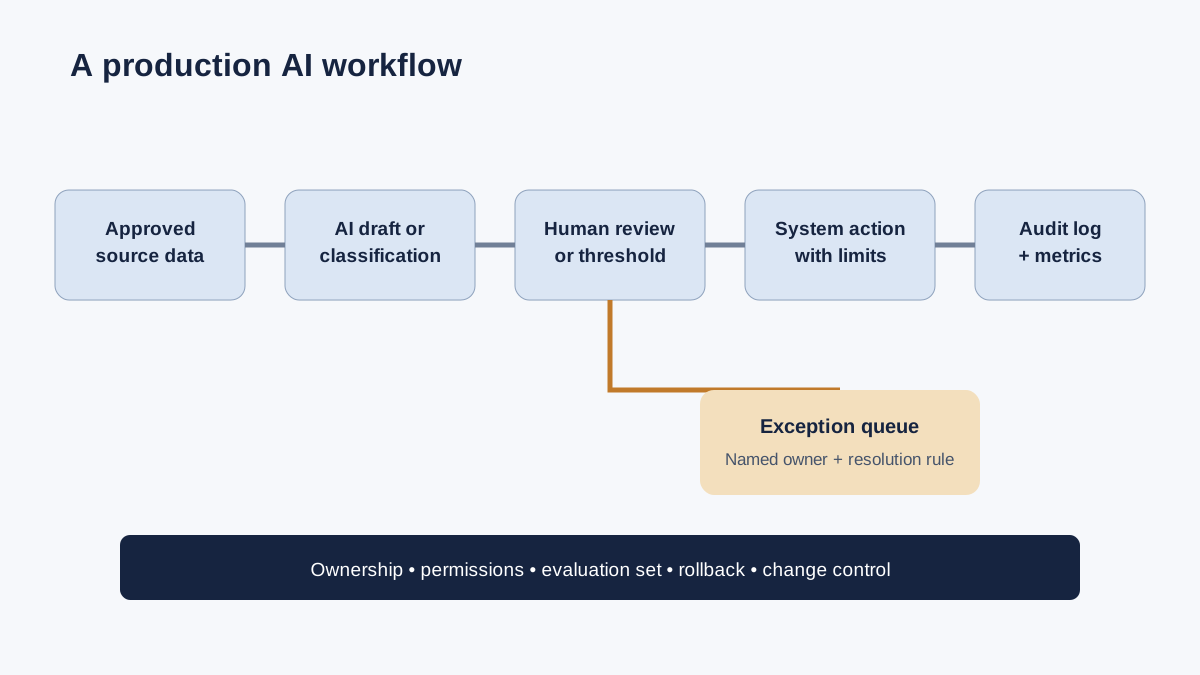
This is not a technology problem. It is a workflow ownership problem. AI that does not attach to a specific recurring task, with a specific person accountable for the output, and a clear standard for what good looks like, will almost always be abandoned.
Where AI actually creates value in the lower middle market
The highest-value AI applications in founder-owned and lower middle market businesses are not the flashiest. They are the ones that reduce the manual assembly work that already happens every month: building the <a href="/insights/management-package-buyers-trust" class="subtle-link">management package</a>, preparing for the <a href="/insights/operating-cadence-management-reviews" class="subtle-link">operating review</a>, summarizing variance against budget, answering questions about customer history or contract terms.
These tasks have something in common. They are repetitive, they require judgment assistance rather than judgment replacement, and they have a human reviewer at the end. That combination — repetitive, judgment-assisted, human-reviewed — is where AI creates reliable operating value.
What makes implementation land
Successful AI implementation in this context has three non-negotiable elements. First, a clear workflow: a specific task, a specific frequency, a specific output. Second, ownership: one person responsible for the output quality, with authority to improve the process. Third, a review standard: a shared understanding of what an acceptable output looks like, so the team can calibrate the tool rather than abandon it when the first draft is imperfect.
Businesses that treat AI as a productivity tool rather than a transformation initiative — and that assign it to real workflows rather than standalone experiments — consistently see it stick.
A useful frame for getting started
If you are evaluating where AI belongs in your business, start by listing the five most time-consuming recurring tasks in your finance and operating workflows. For each one, ask whether the task is repetitive, whether the output has a reviewable standard, and whether one person owns the result. The tasks that score yes on all three are your best starting points.
That exercise usually surfaces two or three concrete opportunities. Most businesses do not need more than that to demonstrate meaningful value in the first 90 days.
Work with Glacier Lake Partners
Schedule an AI Workflow Consultation
Get a practical implementation plan for the two or three workflows that create the most value in your business.
Start a Conversation →AI implementation scan
See which AI workflows are actually ready now.
Get a practical score, priority workflow list, and 30/60/90-day implementation path.
Run the AI workflow scan →Research sources
Disclaimer: Financial figures and case-study details in this article are anonymized, composite, or representative examples based on middle market operating situations, and are not guarantees of outcome. Statistical references are drawn from cited third-party research; individual transaction and operational results vary based on business characteristics, market conditions, and deal structure. This content is for informational purposes only and does not constitute legal, financial, or investment advice. Consult qualified advisors for guidance specific to your situation.
Explore adjacent topics