
Key takeaways
- Strategic buyers pay 0.8–1.3x EBITDA higher multiples on average, but PE buyers require 10–30% rollover equity that can produce a second payout exceeding the initial proceeds in a successful hold.
- Earnouts appear in 45% of PE-led LMM transactions versus 30% of strategic deals, PE buyers have higher post-close founder dependency and they structure for it.
- A strategic offer of 9x cash-at-close can be economically equivalent to a PE offer of 7.5x plus 15% rollover equity expected to return 2x over five years, model the full proceeds, not the headline.
- Post-close life is the most underweighted factor: strategic acquisitions typically end the founder's operating role within 12–24 months; PE transactions often require 3–5 more years of active leadership.
In this article
- How PE buyers and strategic buyers evaluate the same business differently
- What the post-close life actually looks like
- Earnouts and rollover equity: the structural differences
- Diligence intensity and process differences
- Choosing the right buyer type for your situation
- How non-compete terms differ between PE and strategic buyers
- How to reference-check a PE firm or strategic acquirer before you choose them
- The decision framework
- Common mistakes founders make when choosing between PE and strategic buyers.
- Price and structure: what each buyer type actually puts on paper
- Post-close life: what the founder role actually looks like under each buyer
- Valuation structure: why an 8x PE offer and a 7.5x strategic offer may net the same
- Process differences: speed, approvals, and engineering competitive tension
- When a PE buyer uses an earnout to bridge to your valuation
- Running a dual-track process: getting both buyer types to compete
How to use this before a process
Earnout Terms to Lock Before LOI
- Define the metric, measurement period, accounting rules, and dispute process in writing.
- Model the payout at base, downside, and buyer-controlled operating scenarios.
- Cap overhead allocations and integration charges that can move the metric after close.
- Require reporting access during the earnout period, not just after a missed payout.
- Know what happens if the buyer sells, merges, or reorganizes the acquired business.
Strategic buyers acquire at a median EBITDA multiple 0.8 to 1.3x higher than financial sponsors in comparable lower-middle-market transactions, reflecting synergy value and elimination of a competitive threat (GF Data 2025).
PE sponsors require founders to roll 10 to 30 percent of equity in the majority of lower-middle-market transactions, making post-close rollover performance a significant component of total founder economics (SRS Acquiom 2025).
Earnout structures appear in approximately 30 percent of strategic acquisitions versus 45 percent of PE-led lower-middle-market transactions, reflecting the higher ongoing dependency PE buyers place on founder retention and performance post-close.
When a founder-owned business enters a sale process, one of the most consequential early decisions is which buyer universe to pursue. Strategic buyers and private equity firms approach transactions differently, value businesses on different terms, and create fundamentally different outcomes for the founder after close. Understanding those differences before a process starts is essential to aligning the transaction strategy with the actual goals of the owner. The transaction readiness checklist is equally important regardless of which buyer type you pursue.
Readiness Snapshot
What buyers will ask
What exactly triggers payment, and who controls the metric?; Which post-close decisions can change the result without violating the agreement?; How will disputes be resolved if the buyer and seller calculate the metric differently?
What to prepare
Earnout model with base, upside, and downside scenarios.; Draft metric definitions and accounting policy assumptions.; Post-close reporting rights and dispute process summary.
$20-50M revenue range
Most active deal zone for both PE and strategic buyers in the lower middle market
30-45%
Share of founder-led LMM transactions involving PE rollover equity
How PE buyers and strategic buyers evaluate the same business differently
A private equity buyer underwrites a business as a standalone investment with a defined hold period, typically three to seven years. Their valuation is driven by the current earnings multiple they can justify, the operational improvements they can make during the hold, and the multiple they expect to achieve at exit. Because PE buyers do not have existing revenue or cost structures to merge with the acquisition, they rely on the existing management team to execute their value-creation plan. That reliance creates strong incentives for founders to retain meaningful equity stakes and remain operationally involved post-close.
A strategic buyer evaluates the same business differently. They are looking for revenue synergies, market share expansion, cost structure improvements, or technology and capability gaps the acquisition fills. Because they can generate value from combining operations, they can often justify a higher purchase price than a financial buyer who must create all value from operating improvements alone.
What the post-close life actually looks like
Post-close reality is one of the most underweighted factors in exit planning. Founders who optimize purely for headline price sometimes find themselves in a post-close environment that is professionally or personally unsatisfying. Modeling what the first 24 months look like under each buyer type is as important as modeling the proceeds.
In a PE-backed transaction, the founder typically retains day-to-day operating leadership with a new board, a performance plan, and more financial discipline around reporting and accountability. The PE sponsor brings capital for growth and acquisitions, operating expertise, and a defined exit horizon. The founder who rolls equity into this structure is making a second investment in the business, accepting liquidity risk in exchange for the potential for a larger payout when the PE firm exits.
In a strategic acquisition, the post-close environment depends heavily on how the acquirer plans to integrate the business. Full integration into the acquirer's operations typically means the founder's role shrinks or disappears within 12 to 24 months. Tuck-in acquisitions may preserve more operating autonomy, but the founder is always subordinate to the acquirer's strategic priorities. For founders who want a clean exit and a defined transition, strategic acquirers often provide the clearest path.
A $28M specialty distribution company ran a dual-track process, receiving offers from two PE sponsors and one strategic acquirer.
The strategic offer was 1.1x EBITDA higher. The founder modeled post-close scenarios for each: the strategic acquisition meant a director-level role for 12 months, then a planned exit from the business. The PE transaction required a 20% rollover and 3-year operational commitment, with a projected second-bite value 18 months out that made the total economics comparable to the strategic offer within five years.
The founder chose the strategic offer for personal reasons, not financial ones. The modeling exercise surfaced the difference between headline price and total founder economics across a realistic planning horizon.
AI diligence angle
Run a short scan to identify reporting, data room, and workflow gaps that could affect diligence confidence.
Run an AI readiness scan →Earnouts and rollover equity: the structural differences
The deal structures that accompany PE and strategic acquisitions differ in ways that affect total founder economics as much as headline price. Understanding these structural differences before a process starts allows founders to evaluate competing offers on a comparable basis rather than comparing headline numbers that reflect different risk profiles.
Rollover equity is the most significant structural difference. PE buyers in the lower middle market typically require founders to reinvest 10 to 30 percent of their pre-tax proceeds back into the business alongside the sponsor's capital. That rollover is illiquid until the PE firm exits, usually three to seven years after closing. If the business performs well during the hold period, the rollover can produce a second payout that exceeds the initial proceeds. If the business underperforms, the rollover value may be materially below its initial investment.
Earnouts appear more frequently in PE transactions than strategic deals because PE buyers have a higher dependency on founder performance post-close. The earnout mechanics and the risks they carry are consistent across buyer types, but founders should expect more earnout pressure in a PE process than in a strategic sale, particularly if <a href="/insights/owner-dependency-transaction-risk" class="subtle-link">owner dependency</a> risk is identified during diligence.
Diligence intensity and process differences
PE buyers run more intensive financial diligence than most strategic acquirers in the lower middle market, because they do not have the internal knowledge of the industry and competitive landscape that a strategic buyer typically brings. Expect a formal quality of earnings report, a management team assessment, and detailed operational diligence in a PE process. Strategic buyers often rely more on their own industry knowledge and focus diligence on legal, regulatory, and integration risk rather than standalone financial validation.
How to Evaluate a Dual-Track Offer: A Founder Framework
Step 1: Normalize headline economics
Convert each offer to an after-tax, after-rollover, after-earnout range. Compare the realistic case, not just the best case.
Step 2: Model post-close income
If any offer includes continued employment, model that compensation over the expected tenure. It is part of total economics.
Step 3: Assess rollover risk
For PE offers, model the rollover at the same multiple the PE firm is paying. That is the floor. The ceiling depends on performance over the hold period.
Step 4: Evaluate earnout probability
Apply realistic probability weights to any contingent consideration. Not face value, probability-weighted value.
Step 5: Score non-financial factors
Rate each offer on founder involvement preference, employee outcomes, customer relationships, and personal timeline. These often break ties.
Choosing the right buyer type for your situation
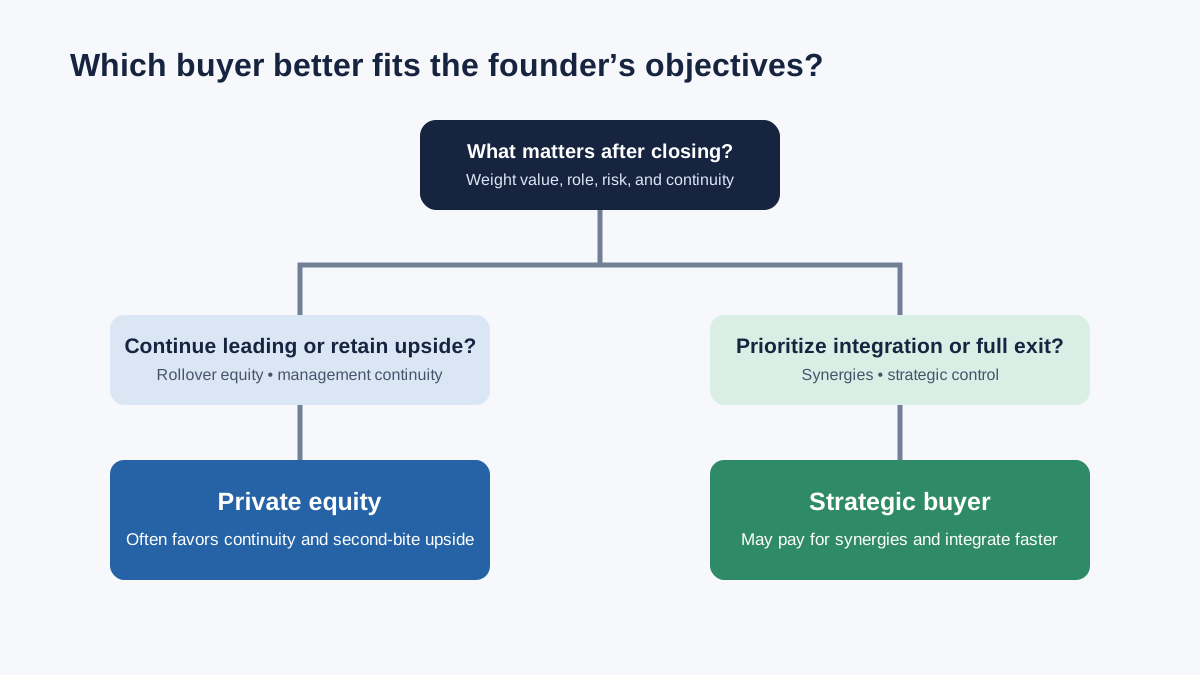
The decision between PE and strategic is not purely financial. It is also a decision about what you want the next chapter to look like. Founders who want a clean exit, full liquidity, and a defined transition tend to be better served by strategic buyers. Founders who want to retain operational leadership, participate in a second exit event, and grow the business with institutional capital tend to find PE transactions more aligned with their goals.
Neither path is universally superior. The best buyer for a given transaction is the one whose structure, post-close expectations, and strategic plans most closely match what the seller actually wants from the outcome, not just the one with the highest headline number.
How non-compete terms differ between PE and strategic buyers
Non-compete agreements are negotiated in almost every lower middle market sale, but the scope, rationale, and negotiating dynamics differ meaningfully between PE and strategic buyers. Founders who understand these differences can negotiate more effectively rather than treating non-competes as a standard formality.
Strategic buyers typically push for the broadest non-compete terms. Their concern is straightforward: they paid a premium for market position, customer relationships, and brand. If the founder reappears in the same market within 24 months, that investment is directly threatened. Strategic acquirers often request 5-year restrictions with geographic scope covering every market the acquired business currently operates in, and product/service scope covering every revenue line. Non-solicitation of customers and employees is standard and typically co-extensive with the non-compete period.
PE buyers approach non-competes differently because the founder is typically staying in the business. The non-compete from a PE buyer is less about preventing competition and more about preventing the founder from abandoning the business and going elsewhere during the hold period. PE non-competes are often structured with a 3-year primary restriction (matching the minimum expected hold period), with the non-compete expiring if the PE firm fires the founder without cause or if the PE firm sells the business within the restriction period.
The most important non-compete negotiation point is the definition of "competition." A restriction on "engaging in any business that competes with the company" is far broader than "soliciting current customers of the acquired business." The first restriction can prevent a founder from working in their industry for years. The second prevents actual customer theft while leaving room for the founder to remain professionally active. Push for customer-based definitions rather than industry-based definitions wherever possible.
How to reference-check a PE firm or strategic acquirer before you choose them
Every PE firm and strategic acquirer presents their best version of themselves during a sale process. References to "partnership," "operational support," and "founder-friendly culture" are universal. The only reliable way to evaluate what post-close life under a specific buyer actually looks like is to talk to founders who have sold to them.
This is called a reference check, and most founders either skip it entirely or do it superficially. A rigorous reference check with 3–5 prior sellers is one of the highest-value activities available during the period between LOI and close. It costs nothing but time and can surface material differences between what a buyer represents and what they deliver.
How to run a PE firm reference check
Step 1: Request a reference list from the PE firm
Ask for 5–7 portfolio company CEOs or founders who sold to the firm; the firm will provide names. Supplement this list with founders you identify independently through your banker or LinkedIn.
Step 2: Identify independent references
The firm-provided list is the starting point, not the ending point. Through your banker, industry contacts, or attorney, identify 2–3 founders who sold to this firm but are NOT on the provided list. These independent references are the most valuable because the firm has not pre-screened them.
Step 3: Prepare your questions in advance
Do not ask "how was your experience?" Generic questions produce generic answers. Ask specific questions that surface specific behaviors.
Step 4: Ask for a 30-minute call, not email
Email produces rehearsed, guarded responses. A phone call produces candid observations because people share what they actually think in conversation.|
Questions to ask a founder who sold to the PE firm
"Did the firm change the deal terms between LOI and closing purchase agreement? If so, how did they handle it?"
"What did the first board meeting look like? Did the firm behave differently once they owned the business than they did during the process?"
"Were there any commitments the firm made during the process that they did not follow through on post-close?"
"How did the firm handle a month where the business significantly missed the operating plan?"
"If you had to describe the operating partner's communication style and frequency, what would you say?"
"Would you sell to this firm again? Would you recommend them to a founder you respect?"
"What do you wish you had known about this firm before you signed the LOI?"
For strategic acquirers, the reference check focuses on different questions, primarily about integration promises versus integration reality, and about the acquired company's treatment after close.
Questions for founders who sold to a strategic acquirer
"How long did you stay post-close, and was that experience what was represented during the process?"
"Did the acquirer follow through on promises about preserving the brand, the team, or the operating model?"
"How were your employees treated during the integration? Were there layoffs that were not anticipated?"
"Did any earnout targets get affected by integration decisions the acquirer made post-close?"
"If you had to characterize the acquirer's integration style, respectful/collaborative vs. absorb-and-standardize, which was it?"
The most important thing a reference check reveals is not whether the buyer is "good" or "bad", it is whether their actual behavior matches what they represented during the process. A buyer who consistently under-delivers on process representations is a buyer who will under-deliver on post-close commitments. A buyer who was direct and transparent during the process, even about difficult topics, is a buyer whose post-close relationship is more predictable.
The decision framework
Buyer Type Selection Framework
Question 1: Do you want to stay?
If yes and with meaningful operating authority → PE. If yes but in a reduced role → either. If no → strategic preferred.
Question 2: Is there a second liquidity event you want to participate in?
If yes → PE with rollover equity. If no → strategic for maximum day-one cash.
Question 3: Does a specific strategic acquirer have synergy value that materially increases the price?
If yes → run a dual-track process; test both; let price and terms decide. If no → PE process may deliver better terms.
Question 4: Is your management team strong enough to operate independently under PE governance?
If yes → PE is viable. If the business's performance is founder-dependent → strategic may be more appropriate, or preparation is required first.
Question 5: Do you want to preserve the business's identity, team, and culture?
If yes → PE strongly preferred. If not a priority → strategic viable.
A founder who sold a $22M specialty contractor to a PE platform at 6.1x received $13.4M at close and retained 18% rollover equity.
Four years later, the platform was sold to a strategic buyer at 9.2x after doubling EBITDA through three add-on acquisitions.
The founder's rollover returned $6.8M on a $2.5M stake. Total proceeds: $20.2M, approximately $5M more than a comparable strategic sale at close would have generated, at the cost of 4 years of PE ownership and the operational discipline it required.
Common mistakes founders make when choosing between PE and strategic buyers.
Price and structure: what each buyer type actually puts on paper
Headline multiple comparisons between strategic and PE buyers obscure important structural differences. Strategic buyers typically pay higher headline multiples but apply those multiples to synergy-adjusted or combined EBITDA, which may differ significantly from your standalone EBITDA. PE buyers apply their multiple to your normalized standalone EBITDA, and that multiple reflects their standalone business risk assessment, not any synergy they might realize.
Typical strategic deal
80–100% cash at close; minimal earnout; no rollover equity
Typical PE deal
70–85% cash at close; earnout common; 5–20% rollover equity
Strategic headline multiple premium
~1.0–1.3x EBITDA on average, structural differences often close much of the gap
Modeling total expected proceeds, not just headline price, requires calculating the probability-weighted <a href="/insights/earnouts-ma-why-founders-dont-get-paid" class="subtle-link">earnout</a> value, the expected rollover equity multiple at the second exit, and the post-tax impact of each deal structure. A strategic buyer offering 9x in cash at close with no rollover may be economically equivalent to a PE buyer offering 7.5x cash plus 15% rollover equity, when rollover is expected to return 2x in a second transaction five years later. Always build the full proceeds model for each offer before selecting.
Post-close life: what the founder role actually looks like under each buyer
The post-close founder experience under a PE buyer and a strategic acquirer are structurally different in ways that most transaction advisors underemphasize. Under a PE buyer, the founder typically retains the CEO title and day-to-day operating authority, rolls 10–20% of equity alongside the sponsor, and operates under a formal board with quarterly performance reviews and a defined 3–7 year hold horizon. The founder is still running the business, but now with institutional accountability, monthly management packages, and a PE partner who is tracking performance against an investment thesis.
Under a strategic acquirer, the post-close dynamic depends on integration depth. In a full operational integration, the founder's role is typically eliminated or converted to a transitional advisory arrangement within 12–24 months. The acquirer absorbs the business into its existing structure, and the founder's operating authority steadily shrinks as integration progresses. Earn-outs are common in strategic deals to keep the founder engaged through the performance period, but the operating reality is that the strategic acquirer's leadership team is making the important decisions from Day 1.
The single most important question a founder should answer before choosing between PE and strategic is: what do I want the next 24 months to look like? If the answer is continued operating leadership with institutional capital behind you, PE is structurally aligned. If the answer is a clean exit within 12–18 months, a strategic acquirer is more likely to deliver it. Neither answer is right or wrong, but confusing the two leads to buyers who are structurally misaligned with the founder's actual post-close preferences.
Valuation structure: why an 8x PE offer and a 7.5x strategic offer may net the same
PE buyers use leverage to pay higher nominal prices than their equity investment alone would support. In a typical lower-middle-market PE acquisition, the buyer finances 40–55% of the purchase price with senior debt, which allows a PE fund to pay a higher headline multiple while deploying less equity capital. The leverage amplifies the PE buyer's equity return on a successful exit but has no direct bearing on what the seller receives at close. The seller receives the same cash regardless of how the buyer finances the purchase.
Strategic acquirers typically pay with cash on hand, stock in the acquirer, or a combination. They do not use acquisition leverage in the same way PE buyers do. However, strategic buyers can justify higher multiples because they capture synergy value, cost savings, revenue cross-sell, and market position advantages that a PE buyer cannot underwrite without owning both businesses. A strategic buyer paying 7.5x on a standalone basis may be underwriting 9.5x on a synergy-adjusted basis, which makes 7.5x economically rational for them.
After accounting for structure, the economics often converge. A PE offer at 8x with a 20% rollover requirement means the founder is effectively reinvesting 20% of proceeds back into the business at the same 8x valuation. If that rollover returns 1.8x at the next exit, the blended economics match a 7.5x all-cash strategic offer. The difference is not the headline multiple, and it is the risk profile and timing of the second liquidity event.
Typical PE deal leverage
40–55% senior debt on enterprise value
15–35% above standalone value in LMM deals
Synergy premium paid by strategic acquirers
10–30% of pre-tax seller proceeds in most transactions
Rollover equity required by PE
A founder received an 8x EBITDA offer from a PE sponsor and a 7.5x offer from a strategic acquirer.
The PE offer required 20% rollover on $16M total proceeds, meaning $3.2M was reinvested into the new PE-backed entity. The strategic offer was all cash at $15M.
After tax at long-term capital gains rates, the strategic offer produced $11.1M in immediate net proceeds. The PE offer produced $9.1M immediately (on $12.8M at-close cash after rollover) plus a projected $4.2M on the rollover at a 1.7x MOIC in 5 years, totaling approximately $13.3M combined but with a 5-year deferral on $3.2M. The founder modeled both scenarios using a present value discount and found the two offers were within 6% of each other in total economic value. The strategic offer won on personal timeline preference, not economics.
Process differences: speed, approvals, and engineering competitive tension
PE buyers and strategic acquirers operate on fundamentally different deal timelines. PE buyers are professional acquirers with dedicated deal teams, standardized diligence processes, and investment committee approval cycles measured in weeks. A well-prepared lower-middle-market PE process from IOI to close typically runs 60–90 days. Strategic buyers operate within corporate development functions that require multiple internal approvals, executive sponsor buy-in, and often board or committee review before an LOI can be signed. A strategic acquisition in the lower middle market typically takes 90–180 days from first meeting to close, and processes exceeding six months are common.
This timeline asymmetry has a direct impact on process strategy. Running PE buyers and strategic buyers simultaneously creates a cadence mismatch that a skilled banker must actively manage. The PE track moves faster; if not managed carefully, PE buyers will push to close before strategic interest has developed into a real offer. The optimal dual-track structure uses the PE track's momentum to create urgency in the strategic process, without allowing the PE track to reach exclusivity before the strategic track has produced a competitive alternative.
Managing Competitive Tension Between PE and Strategic Buyers
Step 1: Launch both tracks simultaneously
Distribute CIM and management presentation materials to qualified PE and strategic buyers on the same day. Never give either type a head start.
Step 2: Set separate IOI deadlines
Give strategic buyers 1–2 additional weeks for IOI submission, acknowledging their longer approval process, while keeping PE buyers on the standard timeline.
Step 3: Use PE IOIs to accelerate strategic interest
When strong PE indications arrive, communicate to strategic buyers that the process is competitive without disclosing specific terms. This creates urgency without breach.
Step 4: Normalize LOI comparisons
When evaluating LOIs, normalize for structure differences (rollover, earnout, exclusivity length) before comparing headline numbers. A PE 8x with rollover and a strategic 7.5x all-cash may be equivalent or in either direction depending on structure.
Step 5: Use best-and-final to maximize both tracks
If both tracks are competitive at the LOI stage, request best-and-final from all serious bidders simultaneously to maximize price and terms tension in the critical pre-exclusivity window.
The most common dual-track execution mistake: allowing the strategic buyer's slower approval process to make PE buyers feel they are in a one-horse race. If PE buyers sense no credible strategic competition, they will hold their best offer in reserve. Your banker must communicate credible cross-track competition without revealing specific terms from either side.
When a PE buyer uses an earnout to bridge to your valuation
One of the most common late-stage negotiating dynamics in a PE process is the earnout-as-bridge: the buyer cannot get to your asking price in upfront cash, so they propose an earnout to close the gap. This is structurally different from an earnout as risk management (compensating the buyer for genuine business uncertainty), it is a pricing tool, and founders who understand the distinction can evaluate it more clearly.
A PE buyer offering $18M upfront on a $22M ask is not saying the business is worth $18M, they may genuinely believe it is worth $22M and more. They are proposing to pay the remaining $4M only if you hit targets they help set. The economic question for the founder is: what is the probability-weighted present value of that $4M, after accounting for operational risk, buyer control over the earnout-period business decisions, and time value of a 24-month deferred payment?
Earnout as Bridge vs. Earnout as Risk Management
The most common founder mistake with bridge earnouts: accepting them without modeling the probability-weighted outcome. If there is a 60% chance of hitting the targets and a 40% chance of receiving $0, the expected value of a $4M earnout is $2.4M. The founder who negotiates the earnout terms down to the last basis point but does not model this scenario is negotiating the wrong thing.
The clearest counter to a bridge earnout is competitive alternatives. A PE buyer using an earnout to close a valuation gap loses that tool if a competing buyer offers upfront cash at the same number. This is the most practical reason for a dual-track process: it limits the structural concessions any single buyer can extract. When only one buyer is at the table, the earnout bridge dynamic is very difficult to resist.
Running a dual-track process: getting both buyer types to compete
The best outcomes for sellers come from situations where both strategic and PE buyers are competing simultaneously. Competitive tension across buyer types forces each to bring their best terms rather than relying on being the only serious option.
Running a dual-track process requires a banker with relationships in both buyer categories for your specific sector, and a process structured to keep both tracks moving at a similar pace. PE buyers move faster, standardized processes, experienced deal teams; strategic buyers require more internal approvals and move more slowly. Your banker must manage the cadence so that both tracks reach the LOI stage simultaneously, or close enough to maintain real leverage.
Dual-Track Process Sequence
CIM distribution
Distribute simultaneously to qualified strategic and PE buyers on the same day with identical materials. Never give one type a head start, it kills competitive tension immediately.
IOI evaluation
Evaluate strategic and PE IOIs on a normalized basis. Adjust for structural differences (rollover, earnout) to compare equivalent cash-at-close economics for each offer.
Management presentations
Schedule strategic and PE presentations separately, the content emphasis differs. Strategics want integration feasibility details; PE buyers want standalone operations and management depth.
LOI stage
Use competitive tension across tracks explicitly. If a strategic submits a strong LOI, communicate that to PE buyers and vice versa, without revealing specific terms.
Final selection
Do not automatically take the highest headline price. Model total expected proceeds for each offer, probability-weight earnouts, value rollover equity, and weight certainty of close for each buyer type.
The single most common dual-track mistake: allowing the strategic buyer timeline to slow the PE track. Strategic processes expand naturally due to internal approval requirements. Your banker must hold the PE track at full speed, using the strategic interest as leverage, rather than letting everything drift to the strategic buyer's schedule. Once PE buyers lose momentum, re-engagement is difficult.
Frequently asked questions
How do PE buyers value businesses differently from strategic acquirers?
PE buyers value businesses as standalone investments, underwriting current earnings plus the improvement they can drive during a 3-7 year hold. Strategic buyers add synergy value on top of standalone value, which typically allows them to pay higher headline multiples. In lower-middle-market transactions, strategic acquisitions price 0.8-1.3x EBITDA higher than comparable PE deals on average (GF Data 2025).
What is rollover equity and why do PE buyers require it?
Rollover equity is the portion of the seller's proceeds that is reinvested into the business alongside the PE sponsor's capital. It aligns the founder's financial interests with the PE firm's investment thesis and signals confidence in the business's performance during the hold period. Most PE-backed LMM transactions require 10-30% rollover; the reinvested amount is illiquid until the PE firm exits.
Is a PE sale or strategic sale better for employees?
There is no universal answer. PE buyers typically retain management teams and may accelerate hiring; their value creation plan usually depends on the existing team. Strategic acquirers may integrate the business into their own operations, creating role redundancies. Founders concerned about employee outcomes should evaluate each offer's integration plan explicitly, not assume either buyer type is inherently more employee-friendly.
Can I negotiate a carve-out for specific activities from a non-compete?
Yes, and this is a standard negotiating point. Common carve-outs include: advisory roles (serving on boards or as advisors to non-competing companies in adjacent industries), passive investments (owning stock in public companies in the same industry), and geographic limitations (restricting the non-compete to specific regions rather than nationwide). Carve-outs should be specified in the purchase agreement, not assumed from general non-compete language.
What happens if I violate a non-compete?
In a properly drafted non-compete, the buyer can seek injunctive relief (a court order stopping the activity immediately without waiting for a full trial) and damages for any proven loss. Non-compete violations in M&A transactions typically trigger escrow claims and can result in disgorgement of deal proceeds. The practical enforcement risk is higher in strategic acquisitions, where the acquirer has strong financial incentive to enforce, than in PE transactions, where the relationship dynamic tends toward negotiated resolution.
Work with Glacier Lake Partners
Discuss Your Buyer Universe
Understanding which buyer type fits your situation before a process starts is one of the highest-leverage preparation decisions.
Start a Conversation →AI diligence angle
See where AI can clean up readiness before buyers ask.
Run a short scan to identify reporting, data room, and workflow gaps that could affect diligence confidence.
Run an AI readiness scan →Research sources
Disclaimer: Financial figures and case-study details in this article are anonymized, composite, or representative examples based on middle market operating situations, and are not guarantees of outcome. Statistical references are drawn from cited third-party research; individual transaction and operational results vary based on business characteristics, market conditions, and deal structure. This content is for informational purposes only and does not constitute legal, financial, or investment advice. Consult qualified advisors for guidance specific to your situation.
Explore adjacent topics