
Key takeaways
- In an asset sale, the buyer and seller must agree on how the purchase price is allocated across asset classes. That allocation is filed jointly with the IRS on Form 8594.
- Buyers prefer to allocate as much value as possible to depreciable and amortizable assets, which generate tax deductions post-close. Sellers often prefer the opposite.
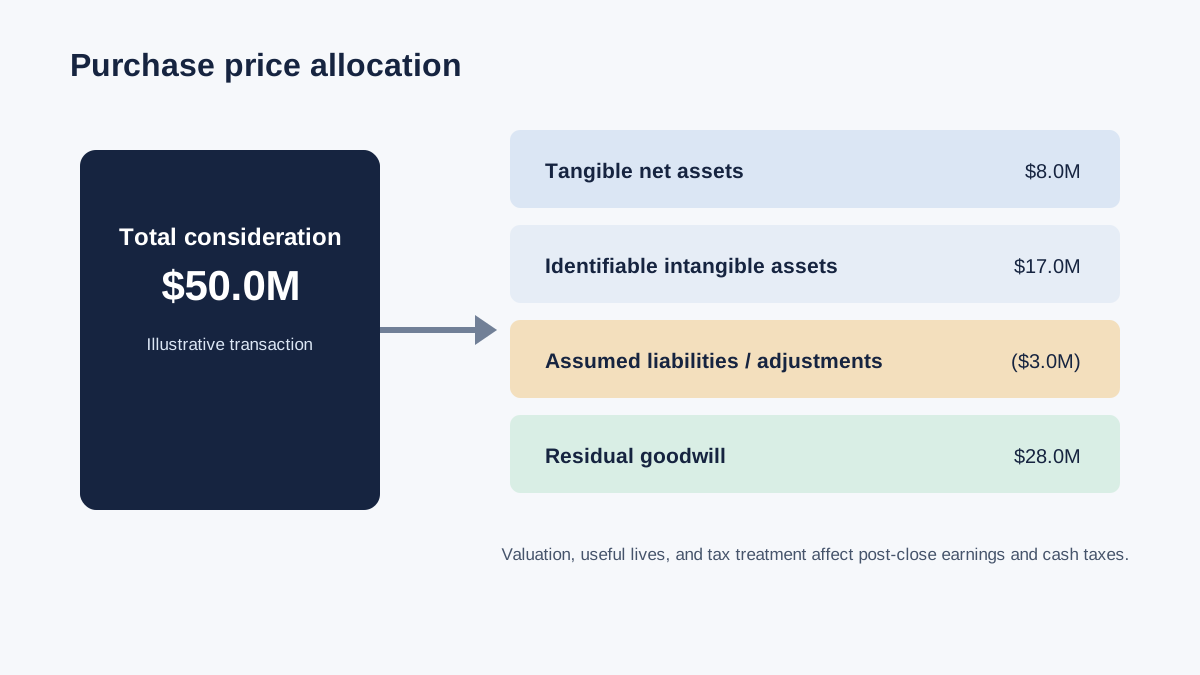
- Goodwill is the residual: everything left after tangible assets and identified intangibles are allocated their fair value. Goodwill is amortized over 15 years for the buyer.
- Identified intangibles, including customer relationships, trade names, non-compete agreements, and technology, are separately valued and amortized over their useful lives.
- In a stock sale, the buyer does not get a step-up in asset basis unless a Section 338(h)(10) election is made, which changes the tax dynamics significantly for both parties.
How to use this before a process
For adjacent context, compare this with PE Ownership After the Close: What Founders Actually Experience in Year One and Managing Your Team Through a Business Sale: What Retention Actually Requires; the strongest operators connect these topics instead of treating them as separate workstreams.
Buyer Diligence Checklist
- Confirm the buyer has authority, capital, and a clear approval path.
- Ask for references from prior sellers, lenders, executives, or capital partners.
- Understand what the buyer plans to change in the first 100 days.
- Compare closing certainty, cultural fit, and structure, not just headline price.
- Keep competitive tension until the buyer proves it can close on the proposed terms.
Readiness Snapshot
What buyers will ask
Does the buyer have authority and capital to close?; What approvals remain after LOI signing?; How has this buyer treated sellers in prior transactions?
What to prepare
Buyer references and prior transaction list.; Capital source, lender status, and approval path summary.; Post-close governance and operating plan outline.
Buyer evaluation path
15 years
IRS amortization period for goodwill and most Section 197 intangibles
$500K–$2M
Typical identified intangible asset value in a $10M–$20M middle market transaction
Form 8594
Joint IRS filing required when assets of a business are acquired
5–7%
Typical valuation fee for a purchase price allocation analysis
Most founders spend significant time negotiating the headline purchase price and deal structure. Very few spend equivalent time understanding what happens to that purchase price in the accounting and tax treatment that follows. The purchase price allocation, known as PPA, is where the deal structure becomes a tax outcome for both the buyer and the seller.
In an asset sale, the buyer is acquiring individual assets rather than the legal entity. Those assets must be assigned specific values. The total of those assigned values must equal the total consideration paid, including assumed liabilities. How the values are distributed across asset classes determines who gets a tax benefit and when.
The IRS asset class hierarchy
The IRS specifies a mandatory class hierarchy for asset purchase allocations under Section 1060. Purchase price is assigned to each class in order, with any remaining amount going to the next class down, until the full price is allocated.
IRS Section 1060 asset class hierarchy
Class I: Cash and cash equivalents
Allocated at face value. If the buyer acquires $200K of cash in the transaction, that is the first $200K of the allocation.
Class II: Actively traded personal property and certificates of deposit
Marketable securities, foreign currency. Common in some transactions.
Class III: Mark-to-market assets and debt instruments
Accounts receivable, loans. AR is typically allocated at net realizable value.
Class IV: Inventory
Allocated at cost or fair market value, depending on the inventory method and the nature of the goods.
Class V: All other assets (tangible personal property)
Equipment, furniture, fixtures, vehicles. Allocated at fair market value. Buyers prefer higher values here because equipment can be depreciated quickly under bonus depreciation rules.
Class VI: Section 197 intangibles other than goodwill
Customer relationships, trade names, non-compete agreements, proprietary technology, licenses. These are amortized over 15 years.
Class VII: Goodwill and going concern value
The residual. Everything left after Classes I through VI are assigned their fair values. Also amortized over 15 years.
The allocation is not discretionary. Once each class is assigned fair market value, any excess goes to the next class. A buyer who tries to allocate $3M to equipment when the equipment is worth $1.2M will have a valuation problem with the IRS. The allocation must be supportable by independent appraisal.
Why buyers and sellers have opposing interests in PPA
Buyers want to allocate as much value as possible to assets that generate the largest and fastest tax deductions. Under current bonus depreciation rules, buyers can immediately expense a large percentage of Class V personal property. Class VI intangibles and goodwill amortize over 15 years, which is slower but still generates tax deductions.
Sellers have different interests depending on what they are selling and how it is taxed. For an individual founder selling a C-corporation in an asset sale, the tax treatment by asset class matters significantly.
The most common negotiating point is the allocation between personal goodwill and non-compete agreements. A founder who can substantiate personal goodwill, the value attributable to their individual relationships and reputation rather than the business entity, may be able to receive capital gains treatment on that portion even in an asset sale. This requires advance structuring and cannot be improvised at closing.
AI diligence angle
Run a short scan to identify reporting, data room, and workflow gaps that could affect diligence confidence.
Run an AI readiness scan →Identified intangibles: what gets valued and why
Between equipment and goodwill sits the most complex layer of the allocation: identified intangible assets. These are assets that do not have physical form but can be separated from the business and valued independently.
Common identified intangibles in middle market transactions
Customer relationships
The value attributable to existing customer contracts and the expectation of renewal. Valued using the multi-period excess earnings method. Duration and renewal rates drive the value.
Trade name and brand
The value of the company name, logo, and associated customer recognition. Valued using the relief-from-royalty method: what would it cost to license the name from a third party?
Proprietary technology or processes
Software, formulas, designs, or processes the company developed that are not separately patented. Valued based on the cost to recreate or the royalty relief approach.
Non-compete agreements
The value of the seller's agreement not to compete for a defined period. Valued based on the realistic probability and economic impact of competition.
Assembled workforce
The value of having a trained team in place. Not separately amortizable under current rules but factors into overall business value.
In a $15M acquisition of a professional services firm, identified intangibles might include $3.5M of customer relationships, $800K of trade name, and $400K of non-compete value. The remaining $8M after tangible assets might go to goodwill. The buyer amortizes all of it over 15 years; the seller pays different tax rates on each piece.
The Form 8594 filing and negotiation in practice
In an asset sale, both buyer and seller are required to file Form 8594 with the IRS, reporting the same allocation. If the two parties report different allocations, the IRS will notice and may challenge both returns.
In practice, the purchase agreement should include an exhibit that specifies the agreed allocation across asset classes. The allocation is often negotiated as part of the overall transaction structure, with each party's tax counsel involved. Founders who do not have tax counsel reviewing the allocation are relying on the buyer's counsel to protect an interest the buyer's counsel does not represent.
A $500K difference in how goodwill versus non-compete payments are allocated can result in a $75K–$150K difference in after-tax proceeds to the founder at a 23.8% capital gains rate versus a 37% ordinary income rate. This negotiation is worth having. It requires a tax advisor, not just a transaction attorney.
A $29M software-enabled services company addressed this issue six months before launching a sale process.
The first review surfaced incomplete documentation and unclear ownership, but the team assigned a functional leader, rebuilt the support file, and created a short diligence memo. When buyers raised the topic later, management answered with evidence instead of explanation.
The result was fewer follow-up requests and no late-stage retrade tied to the issue.
Frequently asked questions
What should a founder do first?
Identify the specific buyer concern this topic creates and assemble the documents that prove the answer. The goal is to make the diligence response evidence-based before a buyer asks the question.
Why does this matter in a sale process?
Because buyers convert uncertainty into price, structure, or diligence friction. A documented answer reduces the perceived risk and keeps the discussion focused on value rather than cleanup.
What is the most common mistake?
Waiting until after LOI exclusivity to fix the issue. At that point the buyer has leverage, the timeline is compressed, and every gap is interpreted through a risk-adjustment lens.
Work with Glacier Lake Partners
Understand the Tax Mechanics Before You Sign
We help founders understand the financial and tax structure of their transaction before they commit.
Start a Conversation →AI diligence angle
See where AI can clean up readiness before buyers ask.
Run a short scan to identify reporting, data room, and workflow gaps that could affect diligence confidence.
Run an AI readiness scan →Research sources
Disclaimer: Financial figures and case-study details in this article are anonymized, composite, or representative examples based on middle market operating situations, and are not guarantees of outcome. Statistical references are drawn from cited third-party research; individual transaction and operational results vary based on business characteristics, market conditions, and deal structure. This content is for informational purposes only and does not constitute legal, financial, or investment advice. Consult qualified advisors for guidance specific to your situation.
Explore adjacent topics