
Key takeaways
- The formal process from banker engagement to close typically runs 7–9 months in current 2025/2026 middle-market conditions; the full timeline including preparation averages 18–26 months for well-prepared businesses and 24–36 months for those with significant gaps
- Skipping the preparation phase is the single most expensive decision founders make, gaps discovered mid-process cost 2–4x more to address than gaps fixed in advance, and QoE adjustments cost $500K–$2M at typical multiples
- Well-run competitive processes (5+ qualified buyers) produce enterprise values averaging 1.2x EBITDA higher than bilateral negotiations, even controlling for business quality
- Exclusivity is the leverage shift: buyers have every incentive to extend the 60–90 day window; sellers with pre-populated data rooms shorten diligence by 3–4 weeks and limit buyers' ability to find additional issues
- The definitive agreement negotiation consistently adds 4–8 weeks beyond what founders expect, the purchase agreement is a 60–120 page document with material economic provisions that both sides contest
In this article
- Phase 1: Pre-engagement preparation (12–18 months before process launch)
- Phase 2: Banker engagement and CIM preparation (weeks 1–10 after engagement)
- Phase 3: Market launch and IOI stage (weeks 10–18)
- Phase 4: Management presentations and LOI negotiation (weeks 16–24)
- Phase 5: Exclusivity and due diligence (weeks 24–38)
- Phase 6: Definitive agreement negotiation and closing (weeks 36–46)
- Common mistakes founders make on the M&A process timeline.
How to use this before a process
For adjacent context, compare this with How to build a management package buyers actually trust; the strongest operators connect these topics instead of treating them as separate workstreams.
Rule of thumb: if a buyer will ask for it in diligence, build it before the process. The same work costs less, creates more confidence, and carries more valuation benefit when it is completed before exclusivity.
Readiness Snapshot
What buyers will ask
Which terms change economics after the headline price is agreed?; What conditions let the buyer delay, retrade, or walk away?; Which obligations survive close and how are they capped?
What to prepare
Marked LOI or purchase agreement term tracker.; Economic impact summary for escrows, holdbacks, notes, and indemnities.; Approval, covenant, and closing-condition checklist.
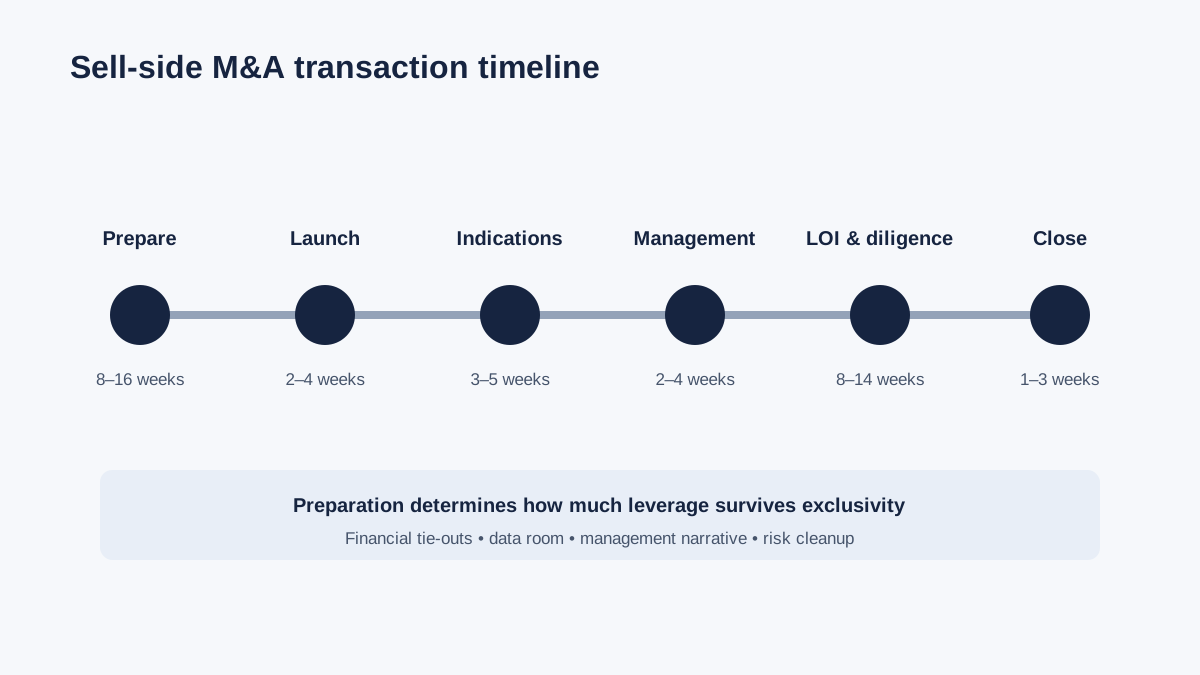
Current 2025/2026 middle-market reporting supports a 7–9 month formal process window from banker engagement to close for prepared lower-middle-market sellers, with longer timelines when buyer financing, QoE findings, or purchase agreement issues surface.
When preparation time is included, the full timeline from a founder first engaging advisory resources to receiving wire proceeds averages 18–26 months for well-prepared businesses and 24–36 months for businesses that begin with material readiness gaps.
Deals that experience at least one re-trade event, a buyer attempting to renegotiate terms after LOI, continue to take roughly 2 months longer to close than deals without re-trades in the most recent SRS Acquiom deal-term studies.
The M&A process is described in pitch decks as a clean, linear sequence of phases. In practice it is a highly variable, frequently parallel, occasionally chaotic process where preparation determines outcomes more than any other single factor. Founders who understand the full timeline, including what happens in each phase, how long each takes, and what determines whether it moves quickly or stalls, are far better equipped to make the decisions that matter. Use the transaction readiness checklist alongside this guide to assess where your business stands before committing to a launch timeline.
Engaging a banker and letting the process run is a natural assumption when selling a business for the first time, the banker manages the timeline, and you show up when needed. In reality, each month of process extension costs $25K–$50K in advisor fees, creates management distraction that affects the business's performance, and gives buyers more time to find issues. The founder who controls preparation controls the timeline.
This guide covers the complete timeline from the pre-engagement preparation that should begin 12–18 months before a formal process through the definitive agreement negotiation and close. The most valuable insight in the timeline is not any single phase, it is the cumulative lesson that the quality of preparation in Phase 1 determines the experience of every phase that follows.
Phase 1: Pre-engagement preparation (12–18 months before process launch)
The preparation phase is the one most founders skip, compress, or treat as optional. It is not. The gaps that surface in this phase, inconsistent management reporting, undocumented EBITDA adjustments, owner-dependent customer relationships, missing contract documentation, are manageable when addressed on your schedule and damaging when discovered by a buyer during diligence.
Pre-Engagement Preparation Priorities
Months 15–18: Self-assessment
Conduct an honest audit of five areas: reporting consistency, EBITDA bridge documentation, management independence, legal documentation completeness, and narrative consistency across the management team. The gaps from this audit become your preparation roadmap.
Months 12–15: Address critical gaps
Standardize management reporting format and apply it without exception. Document every recurring EBITDA adjustment in writing. Begin distributing decisions to management below the founder. Identify and start resolving legal and contract issues.
Months 9–12: Build the track record
Execute the improved systems consistently. Twelve months of consistent management packages, documented cadence outputs, and management independence evidence is what buyers actually underwrite, not the existence of a new system, but the track record of its use.
Months 6–9: Pre-process preparation
Commission a sell-side quality of earnings review. Pre-populate the data room framework. Reconcile tax returns to management accounts for the past three years. Identify every potential diligence finding proactively so you control the narrative.
Months 3–6: Banker selection and engagement
Run a banker selection process. Interview three to five firms. Evaluate sector expertise, deal size fit, process philosophy, and team continuity through the transaction. Execute the engagement letter.
12–18 months for well-capitalized businesses
Typical preparation phase duration
Most common preparation shortcut
Starting with banker engagement rather than self-assessment
Cost of skipping preparation
0.5–1.5x EBITDA in price or deal certainty
The preparation phase is the only phase where you control the timeline completely. Every other phase has a buyer or a market on the other side of the schedule. Use the time you control to build the credibility and documentation that will carry you through the phases you don't.
Phase 2: Banker engagement and CIM preparation (weeks 1–10 after engagement)
The banker engagement phase begins with signing an engagement letter and ends with the Confidential Information Memorandum distributed to prospective buyers. This phase is highly collaborative and typically takes 8–12 weeks for well-prepared businesses and 12–16 weeks for businesses with remaining preparation gaps.
The primary work products of this phase are: the Confidential Information Memorandum (CIM), the financial model, the management presentation framework, and the buyer target list. The CIM is the most consequential document in the entire process, it is what buyers use to decide whether to engage, and it is what they will hold you to narrative consistency against throughout diligence.
CIM Preparation Phase Milestones
Weeks 1–3: Information gathering
The banker collects historical financials, management packages, customer data, contract information, and operational details. Founders should prepare all requested materials immediately, delays here cascade into delays at process launch.
Weeks 3–6: CIM drafting and iteration
The banker drafts the CIM; the founder reviews and corrects for factual accuracy and narrative consistency. The financial model is built and reconciled to management accounts. Management presentation outline developed.
Weeks 6–8: Management presentation preparation
Mock sessions, Q&A preparation, and team readiness assessment. This phase is where preparation gaps that were not addressed in Phase 1 surface and must be managed under time pressure.
Weeks 8–10: Final CIM, NDA list, and process launch planning
CIM finalized. Buyer target list confirmed. NDA template prepared. Confidential process announcement and timeline drafted. Process launch ready.
The CIM is a document that buyers will analyze line by line. Every number must reconcile. Every claim must be defensible. Every narrative about customer retention, growth drivers, and competitive differentiation must be consistent with the financial history. Founders who co-author the CIM with their banker, rather than delegating it entirely, produce more accurate, more credible documents.
AI diligence angle
Run a short scan to identify reporting, data room, and workflow gaps that could affect diligence confidence.
Run an AI readiness scan →Phase 3: Market launch and IOI stage (weeks 10–18)
The market launch phase begins with <a href="/insights/nda-cda-ma-process-guide" class="subtle-link">NDA</a> execution and CIM distribution to prospective buyers. It ends with the receipt and evaluation of Indications of Interest (IOIs), preliminary, non-binding expressions of valuation intent. This phase typically takes 4–8 weeks from CIM distribution to IOI deadline.
During this phase, your banker is running multiple simultaneous buyer conversations while you are maintaining the existing business. This is one of the most operationally demanding periods for a founder, the business continues to require management while the CIM is in market, and any operational problems that surface during this window affect buyer sentiment immediately.
Well-run competitive processes with 5 or more qualified buyers receiving CIMs continue to produce enterprise values about 1.0–1.5x EBITDA higher than bilateral negotiations, even when controlling for business quality and market conditions.
IOI-to-management-presentation conversion rates in lower-middle-market processes average 40–60%: expect roughly half of IOI submitters to proceed to management presentations when properly screened.
Axial reported 12,856 lower-middle-market deals brought to market on its platform in 2025, a 17.1% increase from 2024, reinforcing that qualified-buyer targeting matters more than broad, unfocused outreach.
The IOI stage is also where the pre-LOI negotiation begins. Your banker should be in active dialogue with the top three to four buyers, sharing competitive tension cues and guiding buyers toward their best terms before the LOI stage. Founders who let their bankers run this stage without engagement miss leverage they cannot recover later.
Phase 4: Management presentations and LOI negotiation (weeks 16–24)
Management presentations are 3–5 hour in-person sessions where your leadership team presents the business to a buyer's deal team, operating partners, and often lenders. This is the highest-stakes single event in most processes, buyers make their most significant valuation and confidence decisions based on what they observe in this room.
After management presentations, buyers who are interested submit formal Letters of Intent (LOIs). The LOI negotiation, the pre-LOI window, is where the most consequential terms are set. Once an LOI is signed and exclusivity is granted, your leverage drops sharply. Everything material should be negotiated before the signature.
3–5 hours per buyer
Management presentation duration
1–3 weeks
LOI negotiation window after presentations
Terms set in the LOI that rarely change later
~80% of final deal structure
Management Presentation to LOI Timeline
Management presentations held
Typically 2–4 buyers; 2–3 days total, scheduled over 1–2 weeks
Post-presentation buyer Q&A
1–2 weeks of follow-up questions; signals buyer engagement and interest level
LOI deadline set
Your banker sets a deadline, typically 2 weeks after last presentation, for best-and-final LOI submission
LOI review and negotiation
Engage M&A counsel immediately upon receipt. Negotiate structure, EBITDA definition, working capital methodology, exclusivity length, and rollover requirements before signing.
LOI execution
Sign with the buyer whose fully negotiated LOI terms, not just headline price, produce the best outcome. Enter exclusivity.
The most common mistake in this phase is selecting a buyer based on headline multiple without analyzing the full structure. An offer at 9x with a narrow EBITDA definition, a 35% rollover requirement, and a 90-day exclusivity period may produce lower total proceeds than an offer at 8x with a broad EBITDA definition, no rollover, and 45-day exclusivity. Always model the total proceeds of each LOI, not just the headline.
Phase 5: Exclusivity and due diligence (weeks 24–38)
Exclusivity begins at LOI signing and ends either at closing or, in approximately 25-35% of transactions, with an extension, a re-trade, or a broken deal. The exclusivity period is the most intense phase for the seller's team: buyers and their advisors are submitting information requests, scheduling management interviews, and conducting simultaneous financial, legal, commercial, and operational diligence.
The typical lower-middle-market diligence process runs 10–14 weeks for well-prepared sellers and 14–20 weeks for sellers with preparation gaps or complex issues. Every week of additional diligence time is a week during which the buyer's negotiating position can shift, particularly if issues surface that were not disclosed proactively.
In the latest available lower-middle-market deal-term studies, roughly one-third of transactions experienced at least one material information request that was not satisfied within 5 business days, contributing to timeline extensions of about 3 weeks.
Quality of earnings findings that changed the EBITDA figure by more than 5% from the LOI basis appeared in roughly 40% of transactions, remaining the primary driver of re-trade attempts during exclusivity.
Sellers who provided a pre-populated data room at exclusivity launch (rather than building it during exclusivity) reduced average first-wave information request response time by more than half and shortened the overall diligence period by 3–4 weeks.
Diligence Phase Management
Weeks 1–3 of exclusivity: Data room launch
Pre-populated data room opens. Buyer submits initial information request list (IDR). Assign a single point of contact from your team for all diligence coordination, typically the CFO or an advisor.
Weeks 2–6: Financial diligence
QoE firm (buyer-side) begins financial analysis. Prepare to explain every EBITDA adjustment, every customer, and every variance in detail. Have the sell-side QoE ready to support your positions.
Weeks 3–8: Legal diligence
Buyer's counsel reviews contracts, employment agreements, IP, regulatory matters, and related-party transactions. Have your data room pre-organized by category.
Weeks 6–10: Management interviews
Buyer's operating team interviews your key managers. These are tests of management depth, not just information gathering. Prepared management teams shorten this phase significantly.
Weeks 8–12: Diligence completion and findings
Buyer consolidates findings. QoE report delivered. Legal memos completed. Any findings that affect valuation are surfaced at this stage, this is the re-trade risk window.
Weeks 10–14: Definitive agreement drafting begins
While diligence is completing, M&A counsel begins exchanging purchase agreement drafts.
Phase 6: Definitive agreement negotiation and closing (weeks 36–46)
The definitive agreement phase is consistently underestimated by founders who assume the hard work is done once diligence is complete. The purchase agreement is a 60–120 page document covering representations and warranties, indemnification baskets and caps, escrow terms, working capital adjustment mechanics, <a href="/insights/earnouts-ma-why-founders-dont-get-paid" class="subtle-link">earnout</a> provisions, and management employment agreements. Negotiating it typically takes 3–8 weeks after a complete markup exchange.
The most negotiated provisions in lower-middle-market purchase agreements: the indemnification cap (typically 10–25% of enterprise value), the indemnification basket (first-dollar vs. deductible), the survival period for representations (typically 18–36 months), the working capital adjustment methodology and target peg, and the earnout definitions and measurement periods.
The closing itself involves simultaneous execution of multiple documents, funds flow authorization, and often the resolution of last-minute working capital calculation disputes. Having a complete closing checklist prepared well in advance, with every required document, consent, and signature identified, is the primary way to prevent a closing that everyone expected on a Monday from sliding to Thursday.
Common mistakes founders make on the M&A process timeline.
A $19M EBITDA manufacturing company addressed this issue six months before launching a sale process.
The first review surfaced incomplete documentation and unclear ownership, but the team assigned a functional leader, rebuilt the support file, and created a short diligence memo. When buyers raised the topic later, management answered with evidence instead of explanation.
The result was fewer follow-up requests and no late-stage retrade tied to the issue.
Frequently asked questions
How long does the full M&A process take?
For a well-prepared lower-middle-market business, the formal process from banker engagement to close takes 7–9 months. When preparation time is included, the 12–18 months of financial, operational, and legal readiness work that precedes banker engagement, the full timeline is 18–26 months. Businesses that begin with material preparation gaps should expect 24–36 months total.
What causes M&A deals to take longer than expected?
The most common causes of timeline overruns: financial diligence findings that require explanation or adjustment (42% of deals); management interview gaps that require additional sessions; legal issues discovered in the data room that require negotiation; working capital calculation disputes; and definitive agreement negotiations that exceed initial estimates. All of these are more manageable when preparation is done in advance.
When should a founder start preparing to sell?
The practical answer is: at least 18 months before you want to close. The strategic answer is: now, regardless of your timeline. The same preparation that makes a business more sellable, consistent reporting, management independence, documented processes, clean financials, makes it more valuable and easier to operate. There is no downside to starting early.
Work with Glacier Lake Partners
Request a deal process timeline for your situation
Every process has a different timeline based on buyer type, diligence complexity, and your readiness. We help founders plan and manage the sequence.
Start a Conversation →AI diligence angle
See where AI can clean up readiness before buyers ask.
Run a short scan to identify reporting, data room, and workflow gaps that could affect diligence confidence.
Run an AI readiness scan →Research sources
Disclaimer: Financial figures and case-study details in this article are anonymized, composite, or representative examples based on middle market operating situations, and are not guarantees of outcome. Statistical references are drawn from cited third-party research; individual transaction and operational results vary based on business characteristics, market conditions, and deal structure. This content is for informational purposes only and does not constitute legal, financial, or investment advice. Consult qualified advisors for guidance specific to your situation.
Explore adjacent topics