
Key takeaways
- Escrow typically holds 10–15% of enterprise value for 12–18 months, on a $20M deal that is $2M–$3M you do not receive at close
- The basket (deductible), cap, and survival period are the three variables that define your actual indemnification exposure
- Reps and warranties insurance has largely displaced traditional escrow in deals above $20M EV by shifting indemnity obligations to the insurer
- Negotiate the escrow amount, period, release triggers, partial early release provisions, and the definition of "claim notice" before signing the purchase agreement
- The working capital adjustment and the indemnification escrow are separate mechanisms, both reduce gross proceeds at close
In this article
How to use this before a process
Why Proceeds Do Not All Arrive on Closing Day
For adjacent context, compare this with Earnouts in M&A: Why Founders Don't Get Paid What They Expect and Working Capital Targets in M&A: The Deal Term Founders Underestimate; the strongest operators connect these topics instead of treating them as separate workstreams.
A $20M enterprise value deal does not produce $20M for the founder at close. Between the headline and the check, debt payoff, transaction fees, and escrow holdbacks reduce the net proceeds. Of these, the escrow holdback is the one most founders understand least and negotiate least effectively. On a $20M transaction, it is not unusual for $2M–$3M to remain in escrow for 12–18 months after closing day, subject to claims by the buyer for indemnification of losses arising from breaches of seller representations.
Readiness Snapshot
What buyers will ask
What is ordinary-course working capital for this business?; Which months are distorted by seasonality, inventory, or collection timing?; How does the proposed peg change cash received at close?
What to prepare
24-month month-end working capital schedule.; Account-by-account inclusion and exclusion memo.; Seasonality, inventory, receivable, and payable normalization bridge.
Escrow exists because the purchase agreement contains representations and warranties, statements the seller makes about the condition of the business. If a representation turns out to be inaccurate and the buyer suffers a loss, the buyer has a contractual right to recover. Without escrow, recovering from a seller who has already received and deployed the proceeds would require litigation. Escrow holds a defined fund the buyer can draw against if a valid indemnification claim arises.
The Three Mechanics That Define Your Exposure
The escrow terms in a purchase agreement interact through three variables: the basket, the cap, and the survival period. Understanding these three together determines your actual post-close indemnification exposure, not just what is in escrow, but what portion of it can actually be drawn by the buyer.
The Three Escrow Mechanics That Matter Most
The basket (deductible): Buyers cannot make indemnification claims until cumulative losses exceed the basket threshold. A 1% basket on a $20M deal means the buyer absorbs the first $200K in losses before any escrow can be drawn. Raising the basket eliminates nuisance claims.
The cap: Total seller indemnification liability (excluding fraud) is capped, typically at the escrow amount. Once the cap is reached, no additional claims are possible regardless of actual losses. The cap is your ceiling.
Survival periods: General representations survive 12–18 months. Fundamental representations (title, authority, capitalization) survive 6–10 years. Tax representations often survive the statute of limitations. Claims must be filed before the relevant period expires.
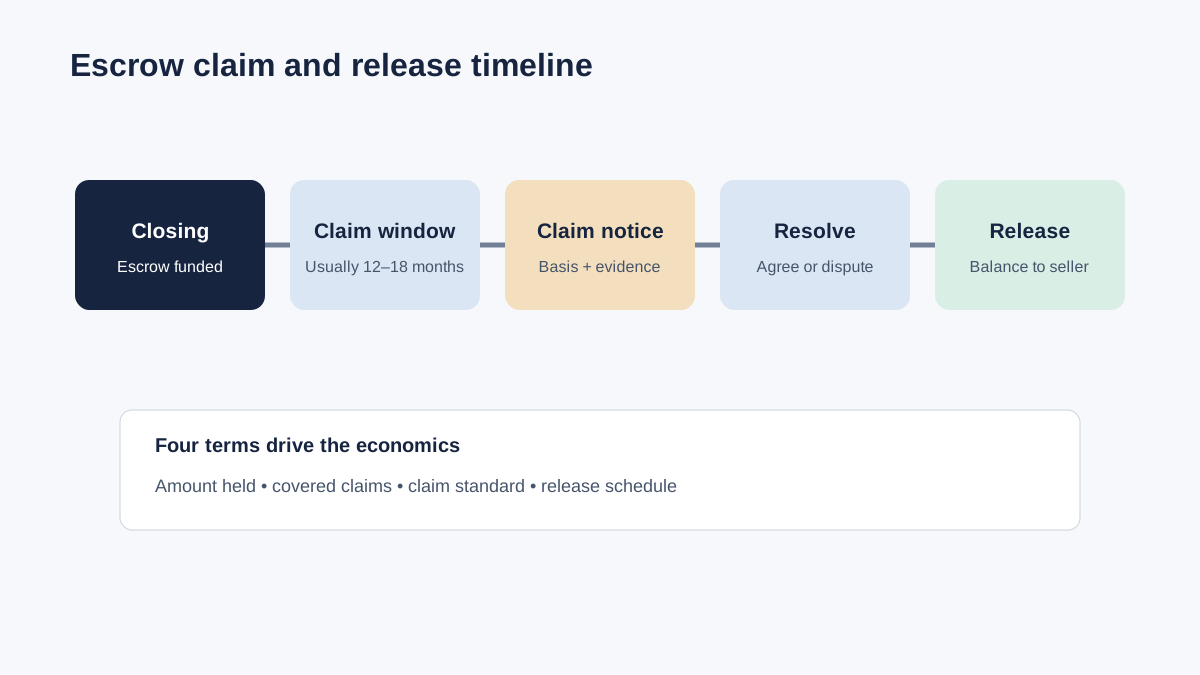
A buyer who believes they have a valid claim submits a written claim notice to the escrow agent and seller within the survival period. The notice must describe the breach, the loss, and the dollar amount claimed. The seller has a defined response period, typically 20–30 days, to dispute or accept. If disputed, the parties negotiate first and then proceed to the dispute resolution mechanism (typically arbitration). If the survival period expires with no claims or all claims resolved, the escrow balance is released to the seller.
Reps and Warranties Insurance and Its Effect on Escrow
In transactions above approximately $20M enterprise value, reps and warranties (R&W) insurance has become the dominant indemnification mechanism. R&W insurance is a policy purchased at closing, typically by the buyer, that shifts indemnification obligations from the seller escrow to an insurance carrier. When R&W insurance is in place, the escrow can often be eliminated entirely or reduced to a small working capital holdback.
From the seller's perspective, R&W insurance is highly favorable: it accelerates receipt of proceeds, eliminates post-close indemnification exposure, and removes the contentious escrow negotiation. The economics work because the insurer prices the policy based on the quality of the business and diligence process, sellers who have done sell-side QoE work and have clean representations are more attractive to insurers and command better terms.
R&W Insurance vs. Traditional Escrow
AI diligence angle
Run a short scan to identify reporting, data room, and workflow gaps that could affect diligence confidence.
Run an AI readiness scan →What to Negotiate Before You Sign
The escrow terms in the initial purchase agreement draft favor the buyer. The seller's job is to negotiate the five variables that determine post-close exposure: the escrow amount, the escrow period, the basket size, the cap amount, and the survival periods. Each is negotiable, and movements in each produce meaningful changes in seller economics.
On a $20M deal, reducing escrow from 15% to 10% releases $1M more to the seller at close. Shortening the escrow period from 18 to 12 months means access to the holdback balance six months sooner. Raising the basket from 0.75% to 1.25% eliminates small nuisance claims that cost more to dispute than to absorb.
One provision worth negotiating is partial early release. Some purchase agreements provide for 50% of the escrow to release at the 12-month mark if no claims are pending, with the remainder releasing at 18 months. This structure accelerates access to approximately half the holdback while still providing buyer protection through the full survival period. Ask for it explicitly, it rarely appears in first drafts.
Also negotiate the definition of "claim notice." If a claim notice can consist of a vague allegation without a dollar amount, the buyer can freeze escrow release indefinitely with minimal effort. Require that claim notices include a good faith loss estimate and a description of the specific representation alleged to have been breached.
The Working Capital Adjustment: Separate From Escrow
The indemnification escrow is separate from the working capital adjustment mechanism, though both reduce proceeds at close. The working capital peg is a target working capital level negotiated during LOI, and the difference between actual working capital at close and the target produces a dollar-for-dollar post-close adjustment. If working capital comes in above target, the buyer pays more. If it falls short, the seller owes a refund.
Working capital adjustments are settled separately from escrow, through a distinct mechanism with a defined post-close measurement period (typically 60–90 days) and a separate dispute resolution process. Confusing the two mechanisms leads to misunderstanding of total post-close exposure. A seller facing both a working capital shortfall and indemnification claims in the same post-close period is managing two different legal and financial processes simultaneously.
Common Questions About Escrow at Closing
Illustrative Escrow Claim
Claim-to-Release Timeline
Claim identified
Buyer documents the alleged breach, covered representation, loss theory, mitigation, and estimated amount.
Notice delivered
Notice is sent before the applicable survival deadline using the method required by the purchase agreement.
Seller review
Seller representative checks timeliness, coverage, calculation, exclusions, and supporting evidence.
Undisputed amount handled
Parties direct the escrow agent to release an agreed amount if the governing documents permit.
Disputed amount reserved
Only the amount reasonably connected to the unresolved claim should remain held where the agreement allows.
Claim resolved
Settlement, expert determination, arbitration, litigation, withdrawal, or other agreed mechanism fixes the payment.
Balance released
Escrow agent releases the scheduled balance after accounting for pending claims, fees, and interest.
Escrow Claim Evidence File
- Executed purchase agreement and escrow agreement.
- Claim notice with delivery evidence and applicable deadline.
- Representation, covenant, or specific indemnity cited by the claimant.
- Documents establishing breach, causation, mitigation, and loss calculation.
- Seller response and chronology of requests, offers, and reservations of rights.
- Joint release instructions, settlement, or final determination.
- Escrow-agent statements showing principal, fees, interest, payments, and remaining balance.
Escrow Versus R&W Insurance
A $31M founder-owned distribution company addressed this issue six months before launching a sale process.
The first review surfaced incomplete documentation and unclear ownership, but the team assigned a functional leader, rebuilt the support file, and created a short diligence memo. When buyers raised the topic later, management answered with evidence instead of explanation.
The result was fewer follow-up requests and no late-stage retrade tied to the issue.
Frequently asked questions
Can the buyer make claims after the escrow period expires?
For most general representations, no, claims must be filed before the survival period ends. But some representations survive beyond the standard escrow period. Fundamental representations (title to shares, corporate authority, capitalization) typically survive 6–10 years. Tax representations often survive until the statute of limitations expires. Fraud claims have no survival limit. Extended-survival claims are covered by the indemnification cap but not typically by the escrow itself, meaning a claim after escrow is released requires the buyer to pursue the seller directly.
What happens to interest earned on the escrow during the holdback period?
Escrow funds are typically held in a money market or government securities account, and interest accrues to the seller. In the current rate environment, 12 months of interest on $2M of escrow can produce $80K–$100K of additional return. Confirm that seller-retained funds include accrued interest, this is specified in the escrow agreement and is sometimes overlooked in deal economics analysis.
Can R&W insurance eliminate escrow even on smaller deals below $20M EV?
R&W insurance becomes economical at $20M+ EV. The challenge at smaller deal sizes is that insurer minimum premiums (often $150K–$250K) represent a higher percentage of deal value. Some buyers and sellers in the $10M–$20M range have found structures combining a smaller escrow with a partial R&W policy that reduces but does not eliminate the holdback.
Is escrow always a percentage of total consideration?
Not necessarily. Some deals set escrow at a fixed dollar amount rather than a percentage, particularly when the deal includes contingent consideration (earnouts) that makes a clean percentage calculation difficult. Fixed-dollar escrows can be favorable if they represent a lower effective percentage than a formula would produce for your specific deal size.
Work with Glacier Lake Partners
Model Your Closing Proceeds
We help founders understand escrow, holdback, indemnity, and working capital mechanics before signing.
Start a Conversation →AI diligence angle
See where AI can clean up readiness before buyers ask.
Run a short scan to identify reporting, data room, and workflow gaps that could affect diligence confidence.
Run an AI readiness scan →Research sources
Disclaimer: Financial figures and case-study details in this article are anonymized, composite, or representative examples based on middle market operating situations, and are not guarantees of outcome. Statistical references are drawn from cited third-party research; individual transaction and operational results vary based on business characteristics, market conditions, and deal structure. This content is for informational purposes only and does not constitute legal, financial, or investment advice. Consult qualified advisors for guidance specific to your situation.
Explore adjacent topics
