
Key takeaways
- An EBITDA bridge decomposes the change in EBITDA between two periods (current vs. plan, or current vs. prior year) into its component drivers: volume, price, mix, cost, and non-recurring items.
- The bridge format prevents the most common management reporting failure: a one-line EBITDA miss explained only as "revenue was lower than plan.
- Non-recurring items should always be separated, lumping one-time costs into the operating bridge obscures whether the underlying business is improving or deteriorating.
- A clean bridge takes 3-4 hours to build for the first time; after that, it should be a 1-hour monthly exercise from a well-structured general ledger.
What a bridge analysis does and why boards require it
What this means in practice: the first improvement is usually not a new dashboard; it is a named owner, a fixed metric definition, and a recurring decision cadence that forces action.
Operator Checklist
- Name the metric, process, or decision this issue affects.
- Assign a single owner with authority to change the process.
- Pull the last 12-24 months of data and identify the pattern, not just the latest month.
- Choose one corrective action that can be tested in the next 30 days.
- Review the result in the next management cadence and document the decision.
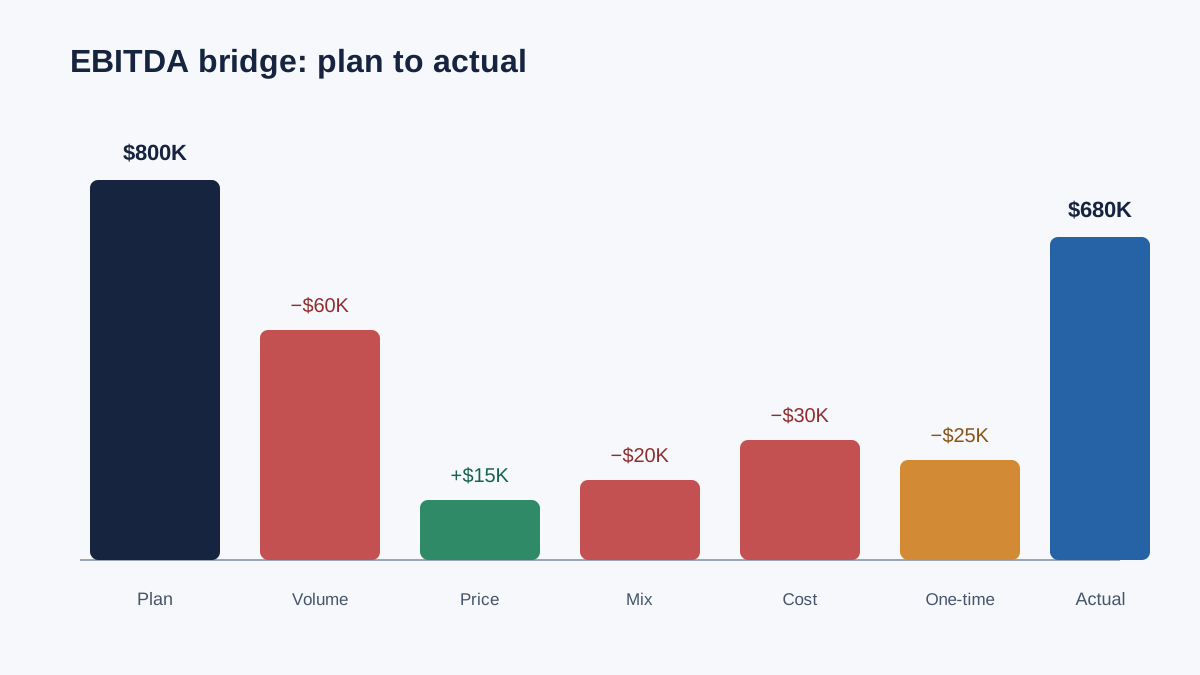
An EBITDA bridge, also called EBITDA bridge analysis or waterfall analysis, explains the change in EBITDA between two periods or between plan and actual. It separates the difference into volume, price, mix, cost, and non-recurring drivers so management can see both what changed and why.
Use the worked price-volume-mix analysis to decompose revenue and gross margin, the procurement savings verification framework to validate cost improvements, and the contract billing leakage audit to distinguish missing invoices from true demand or price variance.
EBITDA Bridge Example: Plan to Actual
Scroll to see more →
Bridge analyses can feel like extra work on top of work, the monthly P&L already exists, and decomposing every variance can seem redundant. The distinction is that the P&L tells the board what happened. The bridge tells the board what to do about it. Those are different questions, and sponsors are paid to answer the second one. The monthly management reporting package guide covers how the bridge integrates into the standard monthly deliverable.
Without a bridge, a $120K miss is a narrative: "Revenue was lower than plan and costs were higher." With a bridge, it becomes a diagnosis: "$60K from lower volume in the services line, $35K from a vendor price increase we didn't anticipate, $25K from a one-time legal settlement." The diagnosis tells management and the board what to act on.
5 components
volume, price, mix, cost, non-recurring, standard bridge structure
3-4 hours
to build the first bridge from a clean GL
1 page
target length for a monthly EBITDA bridge summary
The five components of a standard EBITDA bridge
A standard EBITDA bridge from plan to actual contains five categories of drivers. Each category should be quantified in dollars and explained with one or two sentences of commentary.
Volume variance
The EBITDA impact of selling more or fewer units/hours/jobs than planned, at the planned price and margin. Volume is the pure demand story, did customers buy more or less than we expected?
Price variance
The EBITDA impact of selling at a different price than planned, on the actual volume delivered. Price variances are often mixed: some customers paid list price, others negotiated discounts.
Mix variance
The EBITDA impact of selling a different product or service mix than planned. If higher-margin products underperformed and lower-margin products overperformed at the same total revenue, mix variance is negative.
Cost variance
The EBITDA impact of direct costs (COGS, direct labor) and overhead costs (SG&A) being higher or lower than planned. Separate favorable and unfavorable variances.
Non-recurring items
Items that affected EBITDA this period but are not expected to recur: legal settlements, one-time vendor credits, severance, transaction costs, insurance recoveries.
Each component should reconcile cleanly: Volume + Price + Mix + Cost + Non-recurring = Total EBITDA variance. If they don't reconcile, the analysis is not complete.
Building the bridge from your general ledger
The bridge is only as good as your chart of accounts. A GL that does not separate recurring from non-recurring expenses, or that lumps multiple cost categories into single line items, will produce a bridge that cannot be cleanly decomposed. A well-structured chart of accounts is the prerequisite that makes bridge analysis possible.
Before building your first bridge, verify: direct costs are separated from overhead, all non-recurring items are tagged at the transaction level, revenue is segmented by product or service line at the GL level, and headcount costs include burden (benefits, payroll taxes) rather than just base salary.
Companies with well-structured charts of accounts reduce the time required to produce monthly variance analysis by 40-60% compared to companies that reclassify expenses manually each month.
PE-backed companies that present EBITDA bridges at every board meeting have 35% fewer board-level questions about financial performance than those presenting only income statement comparisons.
The most common bridge error: including budget assumptions that were wrong at inception as "variances." If you budgeted $50K for a vendor contract that was always going to cost $70K, the $20K is a budget error, not an operating variance. Distinguish between performance failures and forecast errors, boards can tell the difference. On a $3M EBITDA business, a $120K unexplained variance, at 7x, represents $840K of enterprise value that the board cannot evaluate without a bridge. The bridge is not overhead. It is the analysis that protects your multiple.
5 drivers
Volume, price, mix, cost, non-recurring
3–4 hours
First bridge from a clean GL
35% fewer
Board questions with a bridge vs. income statement
1 hour
Monthly maintenance once template is set
The EBITDA bridge is not a finance exercise.
It is a management accountability tool.
When every dollar of variance has a named cause and a named owner, the organization learns to run tighter. When it does not, the same variance appears again next quarter with a different label.
What PE sponsors actually look for in bridge analysis: sponsors review bridges to determine whether variances are structural (pricing weakness, customer churn, cost structure problems) or transient (one-time items, timing differences, non-recurring costs). A bridge that clearly separates structural from one-time variance tells the IC whether the investment thesis is intact. A bridge that conflates them forces the IC to make their own assumptions, usually more conservative than the truth.
Common mistakes in bridge analysis
Common Bridge Analysis Mistakes
Frequently asked questions
What is the first practical step?
Start by defining the metric or process owner and pulling the last 12-24 months of evidence. Most operating issues look different once the pattern is visible over time instead of judged from the most recent month.
How does this affect valuation or buyer confidence?
Buyers value repeatable management discipline because it reduces post-close uncertainty. A documented process, named owner, and consistent review cadence make the result transferable rather than founder-dependent.
What is the most common mistake?
The common mistake is treating the issue as a one-time cleanup project. The value comes when the fix becomes part of the recurring operating cadence and management reviews it consistently.
Work with Glacier Lake Partners
Build a bridge analysis template for your business
We help management teams design EBITDA bridge frameworks that make variance explanations clear and defensible to boards and investors.
Start a Conversation →Operating workflow scan
Find the reporting or execution workflow worth automating first.
Turn the issue in this article into a ranked AI workflow roadmap with readiness gaps and estimated time savings.
Find the first workflow →Research sources
Disclaimer: Financial figures and case-study details in this article are anonymized, composite, or representative examples based on middle market operating situations, and are not guarantees of outcome. Statistical references are drawn from cited third-party research; individual transaction and operational results vary based on business characteristics, market conditions, and deal structure. This content is for informational purposes only and does not constitute legal, financial, or investment advice. Consult qualified advisors for guidance specific to your situation.
Explore adjacent topics